Week 1: Why We Need Theory
Reading one: How to Encounter a Puddle by Anny Li
Reading two: Index of Agency by Sophie Chein
What is Li’s overall idea about puddles? How does she connect the practical with the theoretical?
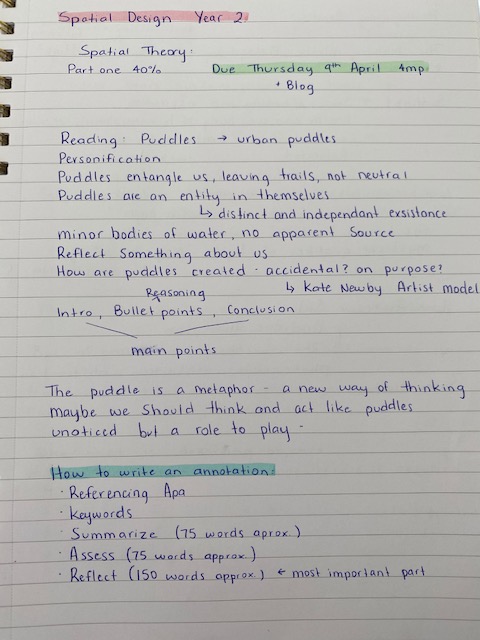
The puddles are metaphors for a new way of thinking. Perhaps we could learn something from puddles, they are overlooked and unnoticed but continue to thrive.
“What can be learned from the humble puddle?”
Li uses a range of images to support her ideas throughout the text. Each image is used as evidence to back up the points she is making.
How might you sum up Chein’s ideas of agency? How does she connect the practical with the theoretical?
In social science, agency is defined as the capacity of individuals to act independently and to make their own free choices. Chien analyses agency in many different situations around the world by both writing and drawing small diagrams. Each scenario has structure that can influence ones agency, such as, social class, religion, gender and ethnicity.
“This project tracks various ways I am consciously performing acts of agency to create a more equitable world for myself and others. It is part of a larger project around socio-spatial frameworks.”
Chein uses hand drawn diagrams to accurately represent her theories about the world and its relationships.
Each writer poses questions within the text. What do you think the purpose of these questions are? How might we answer them?
Each text uses questions as a way of getting the reading to do their own thinking about the topic.
How to Encounter a Puddle:
There are few questions in this text however the few that are asked are linked to the overall theme behind the piece. The simple question of “What can be learned from the humble puddle?” highlights the main idea.
Index of Agency:
The questions in this text are used to encourage the reader to think about how they may make decisions in each of the situations. The answers to the questions asked would vary from person to person as everyone would be influenced by different social structures in each case.
What is the purpose of, or impression you get from the images within each text? How important are they in your understanding of their ideas?
The images and diagrams used in each text help me get a better understanding of the writers ideas. Each bullet point in ‘How to Encounter a Puddle’ has a image that shows where Li’s ideas came from. These photographs help the reader visualise the scenes Li is writing about allowing the reader to get be better understanding of the text overall. The diagrams used throughout ‘Index of Agency’ help me visualize each scenario. Although they are only quick sketches they effectively communicates Chiens thinking.
Theoretical texts and ideas:
Ekistics – a science dealing with human settlements and drawing on the research and experience of professionals in various fields, such as, architecture, engineering, city planning, and sociology.
Agency – the capacity of individuals to act independently and to make their own free choices.
Personal as political – the connections between personal experience and larger social and political structures.
Low theory – to argue that failure to live up to societal standards can open up more creative ways of thinking and being in the world.
Decentralized network – is a “trust less environment,” where there is no single point of failure.
Draft Annotation notes:
How to encounter a puddle is a piece driven by Anny Li’s curiosity towards the puddles seen on the streets of NYC’s financial district. Her curiosity leads to impulsive photography and further shifted to intentional documentation of the puddles. Li began to see puddles as more than just a temporary accumulation of water and bullet points some of her notes on the characteristics of the urban puddle.
Key themes/ideas to expand on:
- Puddles are not neutral / once you have stepped in a puddle you are implicated by it. Think/design like a puddle, leave mark on others with your work.
- Thrives where infrastructure fails. Work when/where others can’t, between spaces, unnoticed, overlooked.
- Flourish in rouge locations.
- Low Theory. Failure can open up more creative ways of thinking.
- Don’t be afraid to break boundaries, interrupt with designs/ideas.
Week 2: Support Structures
Reading one: Too Close to See: Notes on Friendship, A Conversation with Johan Frederik Hartle by Celine Condorelli
Reading two: Support Structures: An Interview with Mark Cousins by Celine Condorelli
How would you define a ‘support structure’ ?
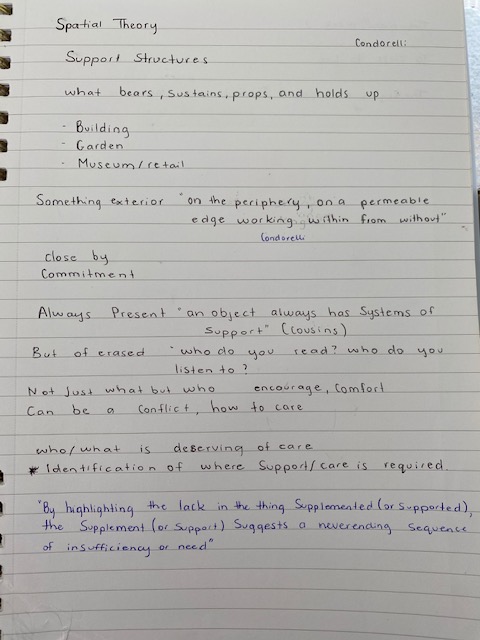
Before this weeks lectures and tutorials I defined support structures solely as something such as scaffolding or garden stakes. Something used to help balance and aid the construction or growth of a building or plant. Now I know that support structures can be more than something that bears, sustains, props and holds up like it is known for in structural terms. Support structures can be seen in all areas of life, particularly in our social life. Structural support in a social sense is the size of the social network available, while functional support is the type of support the network can provide.
What are some examples of ‘support structures’ ? Physical, political, conceptual, etc.
Physical – Scaffolding, garden stake, shelf, book ends, buckets.
Political – votes, money towards charities
Conceptual – vitamins for immunity/health
Social – Family, friends.
What are some conditions or requirements for a structure to be considered a support?
In structural terms conditions for a structure to be considered a support would include the construction or restoration of a building. If a building is unable to stand, support is needed while it is being fixed. Once standing on its own support is no longer required. The same conditions could apply to a friend or family member who is feeling down. Support can help build someone back up to the point they are happy enough to continue on their own. Support in all cases is often temporary, however, is easy to bring back/put back up.
What is the relationship between the supporter and the supported?
There is often a close relationship between the supporter and the supported. In most cases the supporter is physically touching the supported or close by. Conceptually speaking support is a commitment. A promise to be there, to be strong from an object or person that needs the help.
In other cases the supported may not be aware they have supporters or who their supporters are. For example support can be shown by reading a writers work or watching a movie/video. These types of creators are not close with their supports or may not be aware they have any type of support structures.
How might we connect the format of texts (as conversations) to her notions of support?
Both texts are based upon conversations/interviews Celine Condorelli participated in. This style draws upon the fact that conversations are between friends. That talking is a form of a support structure.
What is Condorelli’s creative practice?
Condorelli is an artist, although best known for her publications. Her artworks work across the spheres of both art and architecture.
Can you identify the threads of connection between her writing and her making? What are they?
There is a clear connection between Condorelli’s writing and her work. The art she creates is direct representation of her writing as they are sculptural support structures themselves. These sculptures are places within galleries and look as if they are supporting the buildings they are within.
She identifies ‘friendship’ as having a political dimension. What does she mean by this? How does she discuss this in the text?
Used for personal gain/ power relation
How would you define friendship? What about solidarity?
I define friendship as a mutual bond between two people. This bond is driven by feelings of care, respect and admiration and relies on communication and trust.
Solidarity is a word used to describe a sense of unity within a group. It’s an awareness of shared interests, objectives, standards and sympathies creating togetherness.
Week 3: A Walk in the City
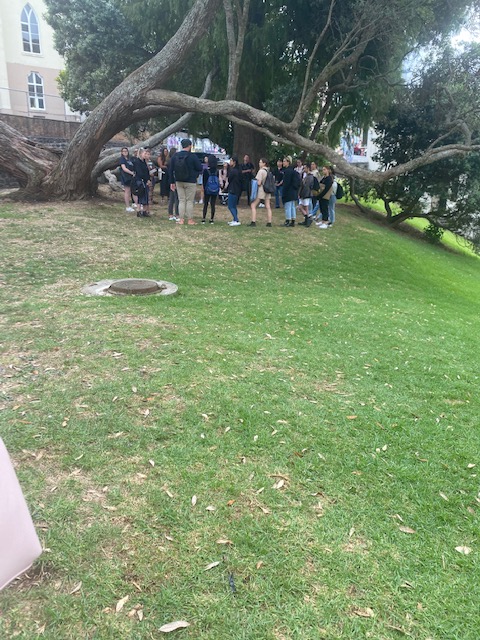
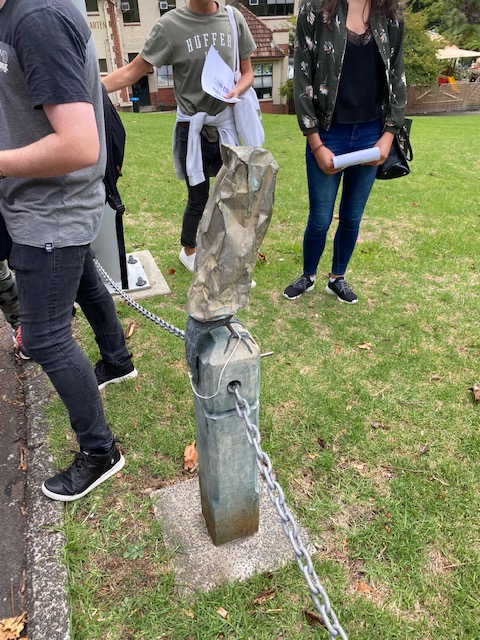
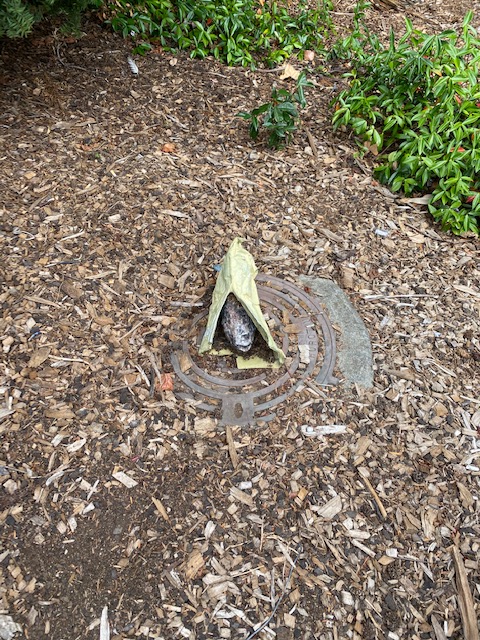
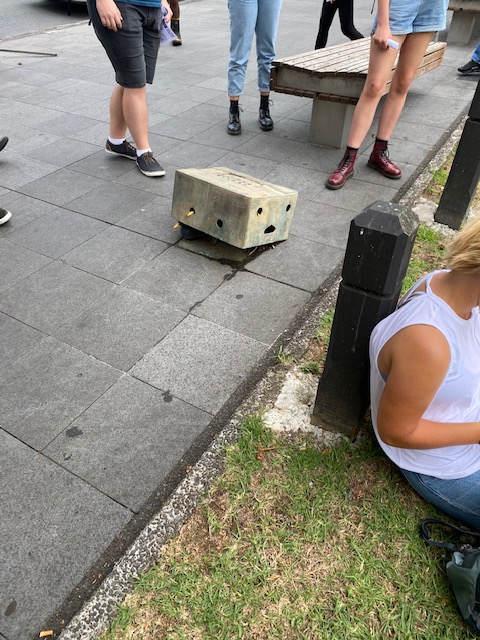
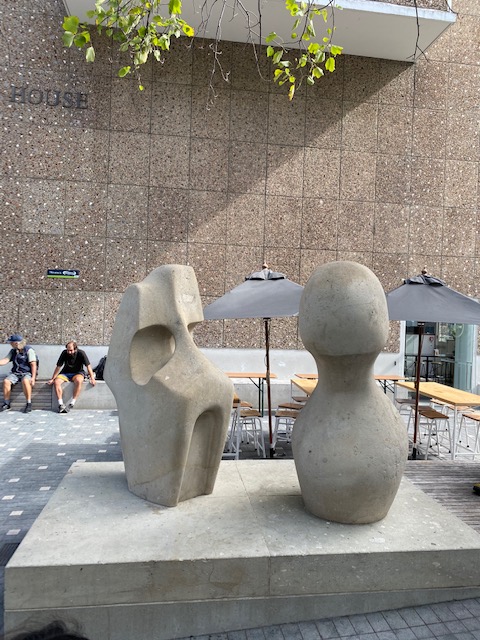
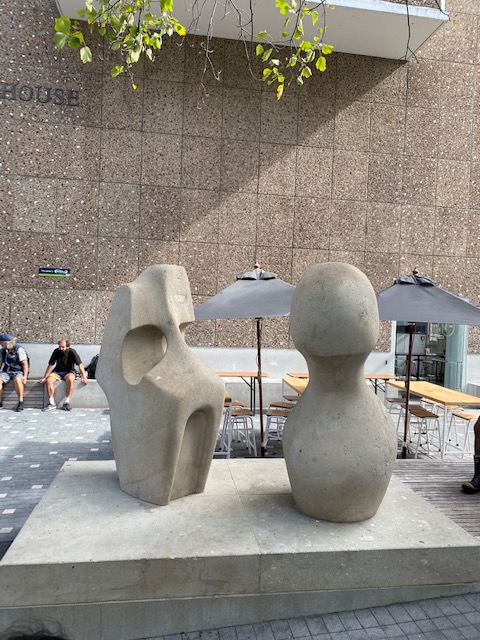
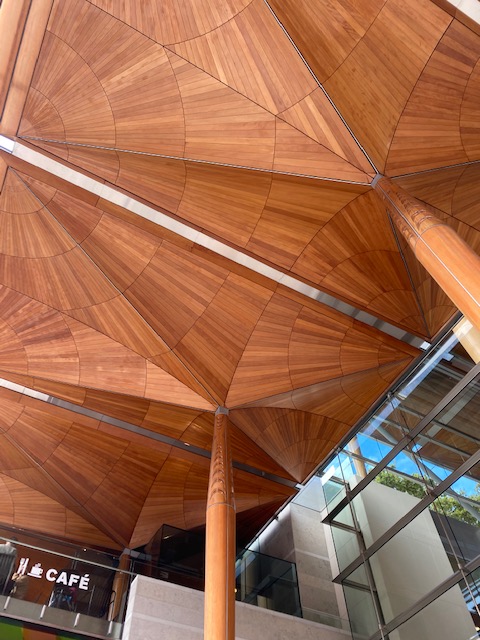
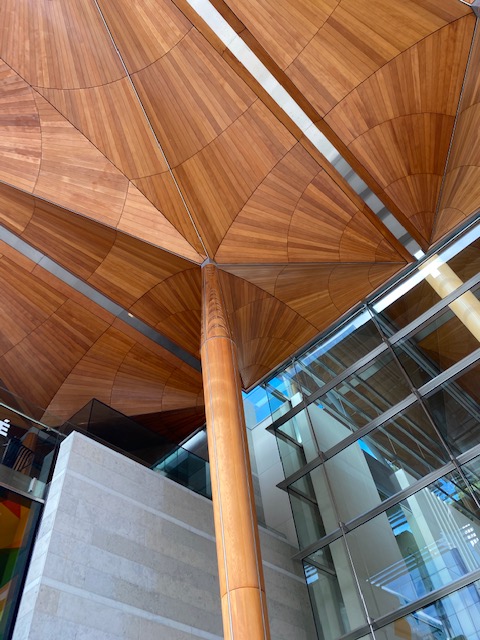
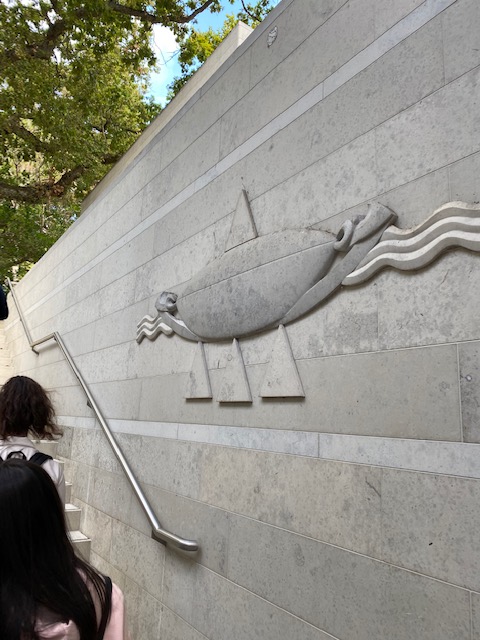
My favourite sculpture we looked at during the walk was the two Maori anchors located on Wellesley street. One sculpture represents the Matahorua anchor, which according to Legend Kupe, sailing in the Matahorua canoe discovered New Zealand and returning to Hawaiki gave navigational directions which the Maori followed many generations later. A stone that lays at the Paremata is claimed to be the Matahorua Anchor.
The second sculpture represents the Tainui anchor. The Tainui canoe sailed to New Zealand in the great Maori migration and after making landfall in the Bay of Plenty area sailed into the Waitemata. It was portaged to the Manukau and sailing south disembarked its complement at Raglan Kawhia and Mokau. A stone which lays the Mokau River is claimed to be the Tainui anchor.
Week 4: Ecologies + Landscape
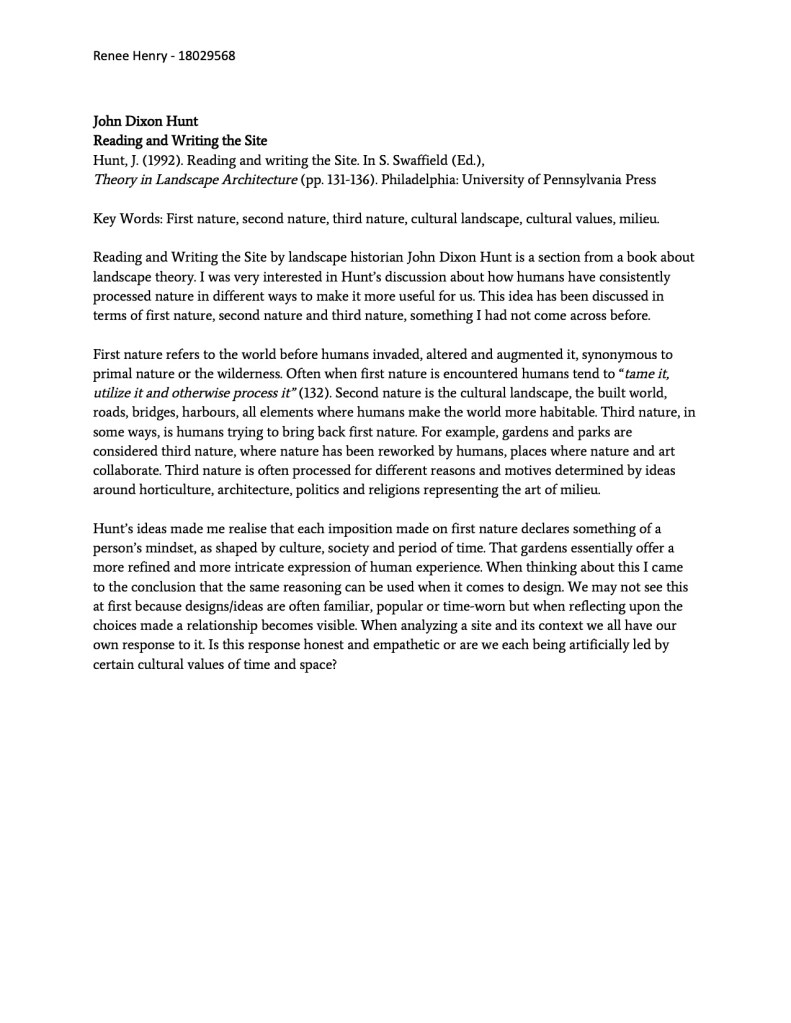
Reading one: Reading and Writing the Site (1992) by John Dixon Hunt
What is “second nature”, according to the Roman writer Cicero? What other term could be used as a synonym for “second nature”, according to John Dixon Hunt? Why is this kind of nature a “second” nature? What is first?
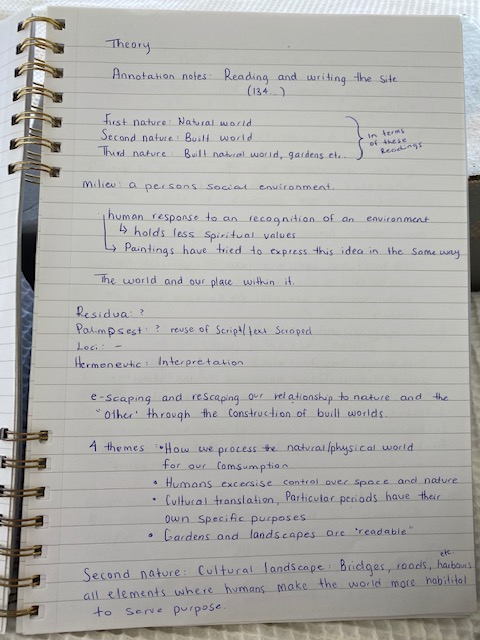
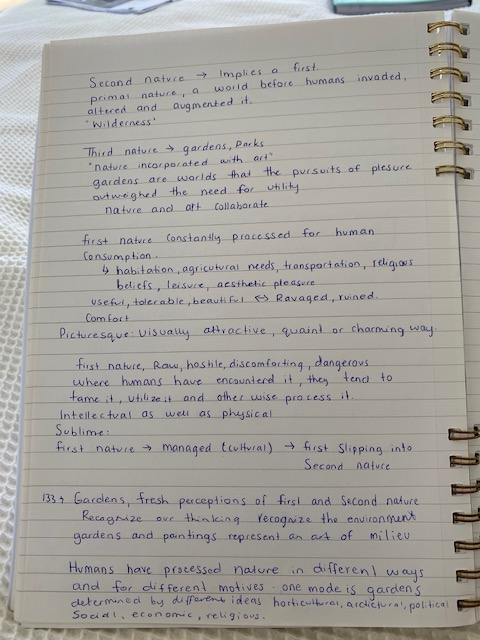
According to Roman writer Cicero second nature is what we would call the cultural landscape. This landscape is made up of bridges, roads, harbours and fields. All places where humans make the world more habitable. The built world. If this is considered second nature, first nature can be seen as the world before humans invaded, altered and augmented it. In other words, primal nature or the wilderness.
What is “third nature” ? Why do you think this is “third”? i.e why is “third nature” said to “go beyond” or be an advance or development upon “second nature”?
Third nature can be seen as rearranged or reworked first nature, for example, parks and gardens. Places where humans have tried to bring back first nature, where nature is incorporated with art. These places of third nature differ from second natures as the purpose of the space is more for aesthetics and pleasure than it is for consumption or habitation.
What does John Dixon Hunt say is the main point he is trying to make when he brings up the terms first, second and third nature? What do these terms tell us about the human relation to nature?
Hunt’s main point is that first nature is the original foundation on which we have built everything, however, we as humans have constantly changed and processed it for our own purposes. Our relationship with nature is that we always use it for our greater comfort or benefit.
“The point to make here is the fashion in which first nature has constantly been processed for human consumption”
What is the “picturesque”? What does this word mean in common parlance? What does it mean in relation to the history of landscape design?
Picturesque – visually attractive, especially in a quaint or charming way. In the history of landscape design and art it relates to a technique/style that where artists were conscious of the manipulation of nature to create foregrounds, middlegrounds, and backgrounds in a move to highlight a selection of provocative formal elements.
What is the “sublime”? What does this word mean in common parlance? What does it mean in relation to the history of art and philosophy?
Sublime – of very great excellence or beauty. In art history the sublime is an artistic effect productive of the strongest emotion the mind is capable of feeling. In philosophy, the term sublime refers to something that is great. This greatness can be physical, moral, intellectual, metaphysical, aesthetic, spiritual or artistic.
What is a garden? How does John Dixon Hunt define the garden, on p. 133? What does the word “miliue” mean? What is its etymological/original meaning?
“a garden itself is a consequence of fresh perceptions of second and first nature”
Miliue – a person’s social environment. A milieu is a surrounding culture. Your family, house, neighborhood, school, and people you hang out with make up your milieu. A milieu is both “surroundings” and everything that makes up the surroundings. Your milieu is your world, or the context you come from.
The etymology of milieu comes down to “mi” and “lieu”. These terms come from the french mi, meaning middle and lieu, meaning place. English speakers have used “milieu” for the environment or setting of something since at least the mid-1800s.
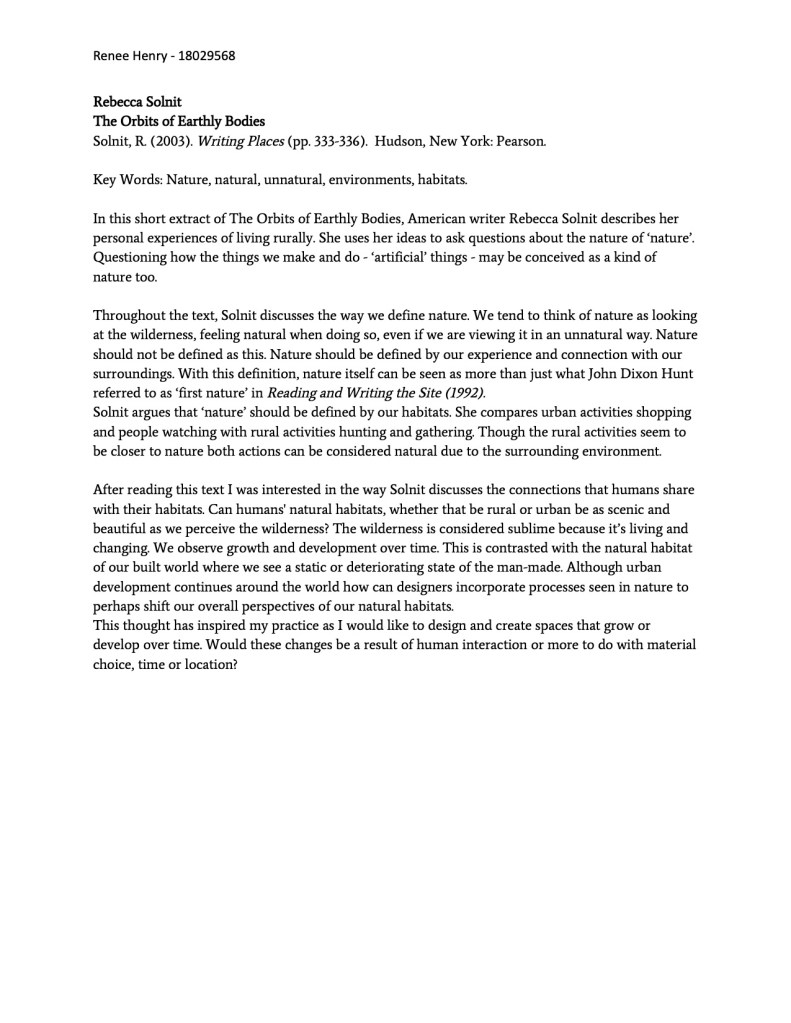
Reading two: The Orbits of Earthly Bodies (2003) by Rebecca Solnit
What is the great irony about living or holidaying in the countryside that Solnit points out in the first few paragraphs of her article?
The great irony Solnit refers to is that even though she/we may be living in a rural area where we are “close to nature” we still find ourselves relying on our cars to get around. She found it hard to maintain a natural lifestyle in these suburban areas as what she needed to do daily was “strictly unnatural”.
Solnit is trying to burst some of our illusions about the countryside. What are some of the common illusions that we have about living or holidaying in the countryside?
A common illusion around the countryside is that everyone who lives in a rural area grow their own food and make staying home their business. In some cases this is true, but more often than not people who claim to be rural have made the countryside into a suburb from which they commute to their real jobs, communities and resources, just like someone who lives in a urban area would.
What are ranchettes? What does Solnit mean when she says that “ranchettes seem to preserve the frontier individualism of every-nuclear-unit-for-itself; they’re generally antithetical to the ways in which community and destiny consolidate resources”?
Ranchette – A small ranch or large home lot, often on the outskirts of a major metropolitan area and just past the planned neighborhoods, consisting of 40 acres and a house and possibly a barn or other outbuildings.
When Solnit wrote the sentence above she is talking about the way ranchettes create a every man for themselves type of environment. Where people do their own thing rather than coming together as a community to share and trade resources.
What is the “new urbanism”? Find out what you can about this movement. Why is Solnit ambivalent about the new urbanism?
New urbanism – is an urban design movement which promotes environmentally friendly habits by creating walkable neighborhoods containing a wide range of housing and job types.
Solnit has mixed feeling about new urbanism as she believes it can be a solution when spaces are designed around public luxury and pedestrian space, however, it will not work when they are dressed up like “Disneys Main Street”.
According to Solnit, how have we tended to define nature? What is wrong with this way of defining nature?
According to Solnit, we have tended to define nature as something we look at and from this we think we are natural when looking at nature. This means that we perceive a scenic view or landscape as nature and feel natural in that environment even if we are viewing it in an unnatural way. Nature should not be defined like this, nature should be defined by experience and connection with our surroundings. With this definition nature can be seen as more than just as what John Dixon Hunt refereed to as ‘first nature’.
Why do you think Solnit compares city activities (shopping, people-watching) to hunting and gathering in the wilderness? Why do you think she says that New York city might be the most natural space in all of America? What is she trying to do to the way we think of cities?
Solnit compares shopping and people watching to hunting and gathering because both or these actions in this instance are quite similar. Both actions can be considered natural depending on the surrounding environment.
According to Solnit, New York may be the most natural space in all of America. Solnit says this for many reasons, one being that urbanism and suburbia are often defined by the way people perceive and engage with time and space. A place where “stockbrokers and janitors daily coexist in the same space and much of the travel doesn’t involve any machines whatsoever”. Solnit wants us to see cities as our natural habitat and place, although there is not much greenery, it is how we interact and live within the space.
What’s the problem with the term “pedestrian scale”?
Pedestrian scale – elements that are designed and customized for pedestrian activity.
The problem with this is that space are being designed for pedestrians without much consideration for the transport machines that are used.
Why do you think Solnit included a found quote from a Pottery Barn catalogue as her epigraph? What does the epigraph tell us about the point she is trying to make in the essay?
“I live in the city but I dream of moving to the country at least once a week”
This quotes relates to Solnit’s own experiences and relates to the way she sees both spaces as a form of nature.
Reading 3: The Ecological Thought by Timothy Morton
Ecological – relating to or concerned with the relation of living organisms to one another and to their physical surroundings.
In this extract of The Ecological Thought, Timothy Morton argues that all forms of life are connected in a vast, entangling mesh. This interconnectedness penetrates all dimensions of life. No being, construct, or object can exist independently from the ecological entanglement. Realising this interconnectedness is what Morton calls the ecological thought.
Points/Quotes I found interesting:
- “The ecological thought insists that we’re deeply connected even when we say we’re not. Thinking itself is an ecological event.” We continue to believe that we have been placed or embedded into this world.
- “Thinking the ecological thought is difficult: it involves becoming open, radically open— open forever, without the possibility of closing again.” Some people struggle with thinking in this type of way. I believe that I’m becoming better at this way of thinking through the theory papers and reading new content each week, opening up my mind to new ideas and concepts.
- “Art forms have something to tell us about the environment, because they can make us question reality.“
- “truly a case of the aesthetics of Nature impeding ecology and a good argument for why ecology must be without Nature. Why is a wind turbine less beautiful than an oil pipe? Why does it “spoil the view” any more than pipes and roads?” Do people care more about the way the environment looks over what is environmentally friendly? Do people think they are caring for nature just because they think it looks nice? “Perhaps it’s this very visibility of choice that makes wind farms disturbing: visible choice, rather than secret pipes, running under an apparently undisturbed “landscape”.
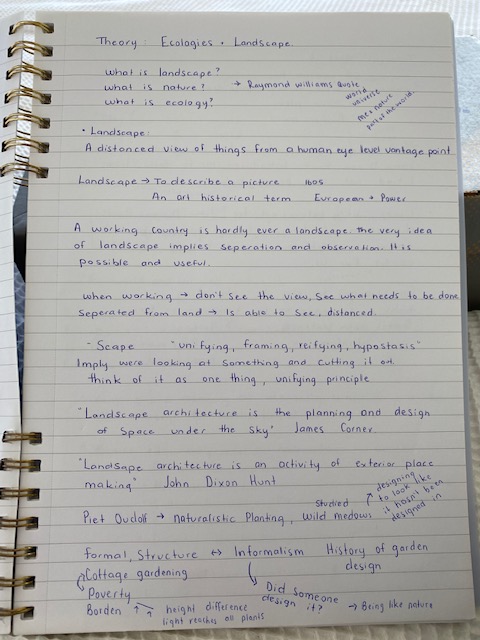
After this weeks readings its become clear that this is an area of design that I am quite interested in. I’ve enjoyed thinking about nature as more than just the wilderness and how the themes from these readings could impact my future and current practice.
Week 5: Archives + Installation
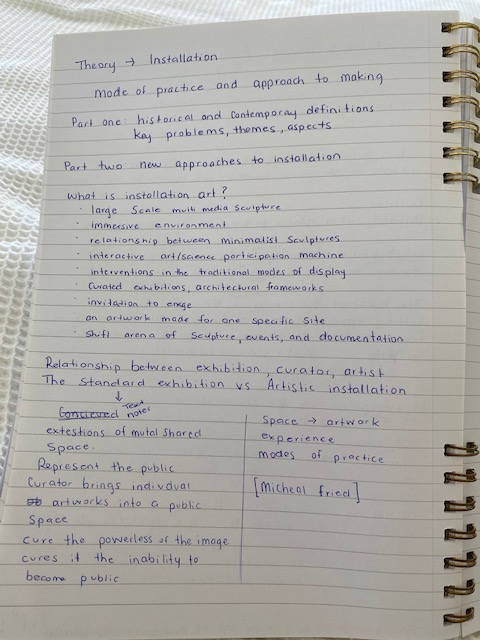
Reading: Politics of Installation by Boris Groys
How does Groys describe the relationship between the ‘field of art’ and the ‘art market’?
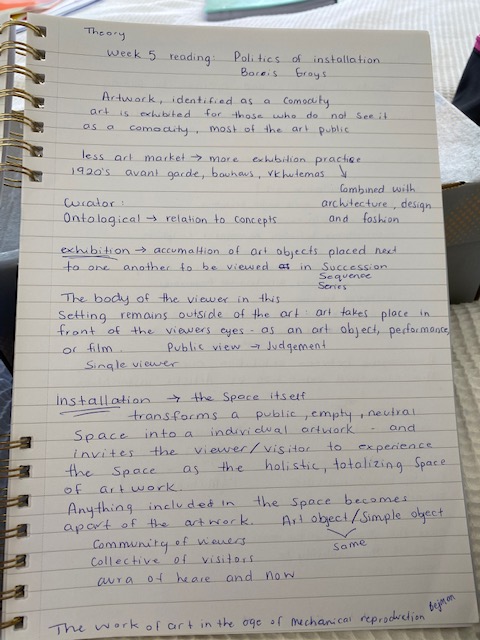
“The field of art is today frequently equated with the art market, and the artwork is primarily identified as a commodity. That art functions in the context of the art market, and every work of art is a commodity, is beyond doubt; yet art is also made and exhibited for those who do not want to be art collectors, and it is in fact these people who constitute the majority of the art public.“
Groys describes the relationship between the ‘field of art’ and the art market” to be equated, meaning that they are viewed as the same. That art is only identified as a commodity, something to be brought and sold.
What is the main two concepts that he seeks to differentiate through an ‘analysis of difference’ at the
bottom of page one?
Groys seeks to analyse the difference of the two main figures of the contemporary art world: the artist and the curator.
How is an art exhibition and an art installation different in Groys’ view? How does he describe the viewer/audience in relationshp to each?
Art exhibition – in Groys view, a art exhibition is an accumulation of art objects placed next to one another to be viewed in succession. In this setting, the body of the viewer remains outside of the art. Art takes place in front of the viewers eyes, as an art object, performance or film. An artwork has a single viewer.
Installation – an installation in Groys opinion is the space itself. The installation transforms a public, empty, neutral space into a individual artwork. The art invites the viewer/visitor to experience the space as the holistic, totalizing space of artwork. Anything within the space becomes the artwork. An installation creates a community of viewers. Visitors view the space as a collective experiencing the space together.
How would you describe an ‘exhibition’? How does Groys describe the ‘exhibition space’?
When I think about an exhibition I think about a public display of art, typically indoors. I would describe it as being an organised series/presentation of selected art.
Groys description – an exhibition is an accumulation of art objects placed next to one another to be viewed in succession.
What is the role of a ‘curator’, both in the past and in the present time?
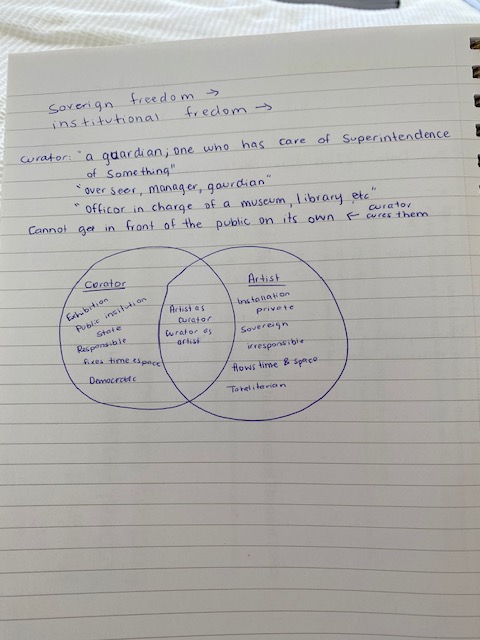
“Accordingly, the curator’s role is to safeguard its public character, while bringing the individual artworks into this public space, making them accessible to the public, publicizing them.”
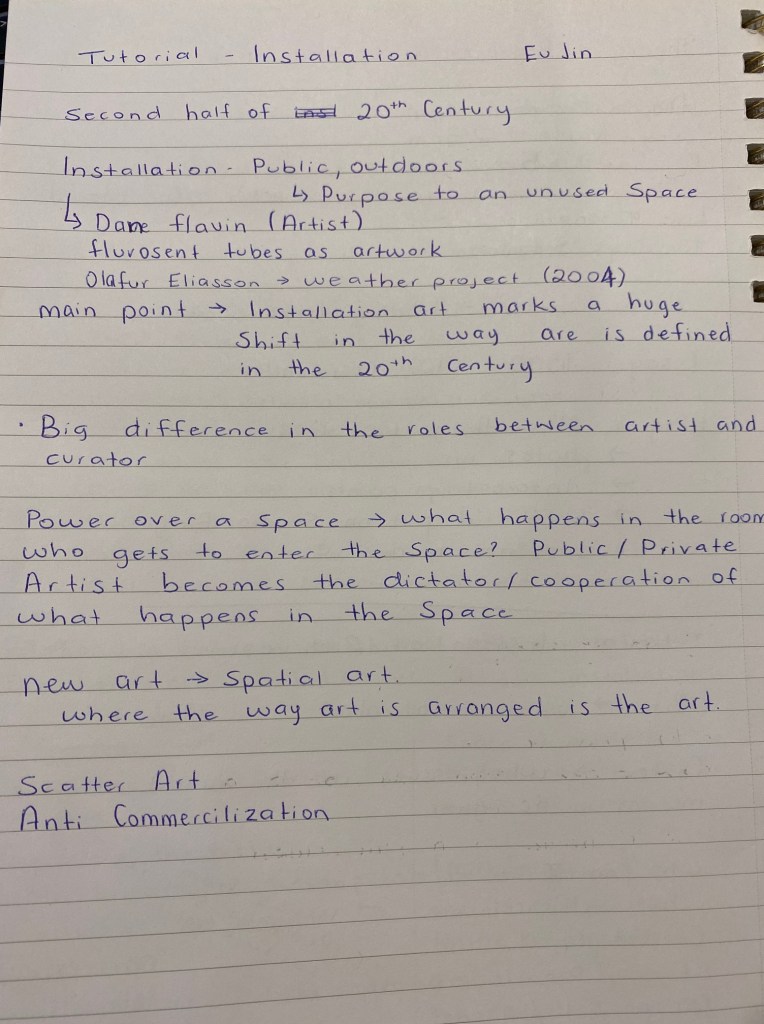
A curator is known as the overseer, the manager or guardian of the space. With art exhibitions the curator selects works and displays them within a space. In this case the curator is responsible for the art of the space itself. In the present where installations are more common their is a big difference between the roles of the artist and the curator. The artist in a sense does the curators job for them as they design the space as the artwork – spatial art.
What do you think a “defunctionalized design fragment” is?
To be defunctionalized means to take somethings functionality away. The statement “defuntionalized design fragment” could possibly mean by turning something into a piece of art you are taking the functionality of the object away. You now just look at it rather than it being useful. ??
When, in Groys’ view, did artists begin to seek autonomy/freedom/sovereignty for their work?
Modern era.
Late 20th century – Installation art marked a huge shift in the way art was defined.
How would you describe an ‘installation’? How does Groys describe the ‘installation’ as a space?
I would describe an installation as an experience, art that changes the way viewers perceive the space.
Groys describes an installation simply as the space itself. Everything with in the space is the artwork.
What does an installation do to a space, that an exhibition does not?
An installation allows you to experience a space, transforming how a space is seen or perceived. An exhibition does not give the viewer an experience, just something to look at.
In relationship to last week’s lecture (Landscape Part II), do you see any relationship between ‘installation’ and colonisation or land ownership?
Land ownership means you have control over what happen/is allowed with the space/area. In some ways an installation is an artists way of having power over a space. The artist dictates and controls what happens within the given space.
What different kinds of ‘freedom’ does Groys write that artists and curators embody? Is it always the same or has it changed over time/ in different situations?
I would say it’s easier to make art in the present day as everything is easy accessible. Material and inspiration is all around us therefor artists and art makers have a lot more freedom to create then possibly in the past as it may have been harder to get things such as paint and canvases etc. In saying this I think there is less freedom on the curators end. So much art has been made from the beginning of art till now where art takes on many forms. Old art pieces take up many of the spaces within museums and galleries (not that that is a bad thing). This means there less freedom for the curator to choose what could be displayed as there is less space.
“The freedom to create art according to one’s own sovereign will does not guarantee that an artist’s work will also be exhibited in the public space. The inclusion of any artwork in a public exhibition must be—at least potentially—publicly explained and justified. Though artist, curator, and art critic are free to argue for or against the inclusion of some artworks, every such explanation and justification undermines the autonomous, sovereign character of artistic freedom that Modernist art aspired to win; every discourse legitimizing an artwork, its inclusion in a public exhibition as only one among many in the same public space, can be seen as an insult to that artwork. “
How does Groys see installation art as reflecting contemporary society? Can we see spatial design and architecture in a similar light? Why/Why not?
Groys see’s an art installation as something that creates and shapes a community of observers. Similarly in contemporary society communities are formed through other things such as concerts, festivals and movies etc. In both circumstances groups of people come together to experience the same thing without knowing others, lacking a shared history. In some ways architecture and spatial design can be viewed in a similar way. People gather in buildings and places to observe or be a part of something that is going on.
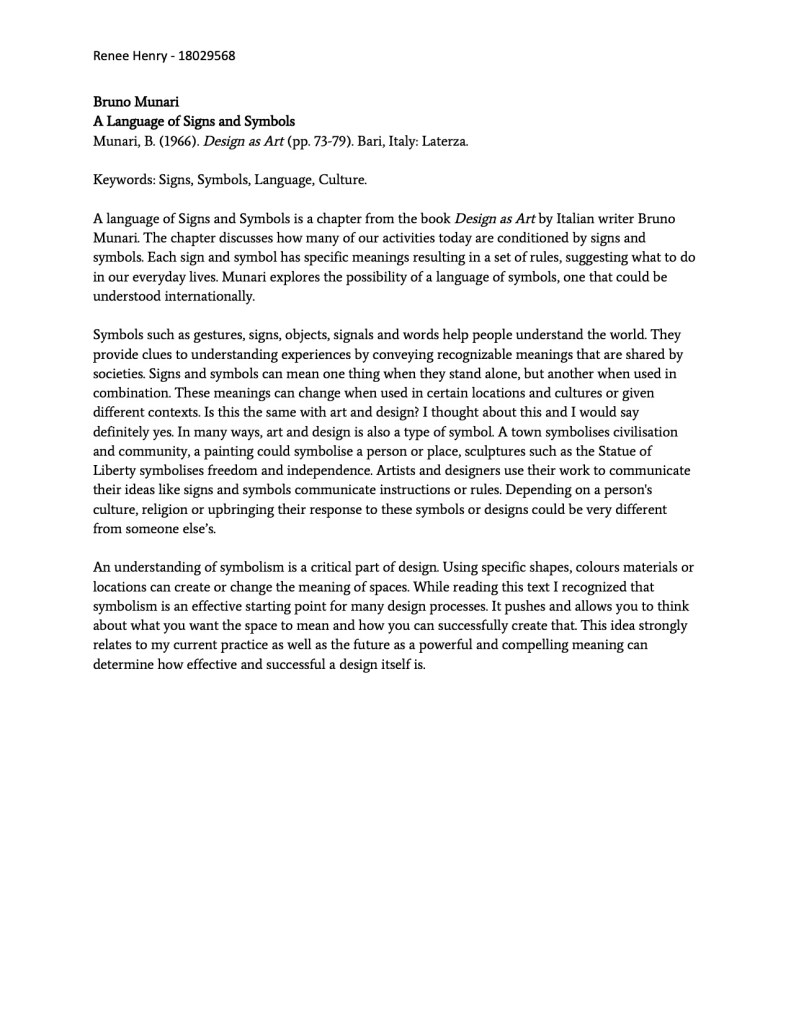
Self Chosen Resource 1: A Language of Signs and Symbols by Bruno Munari
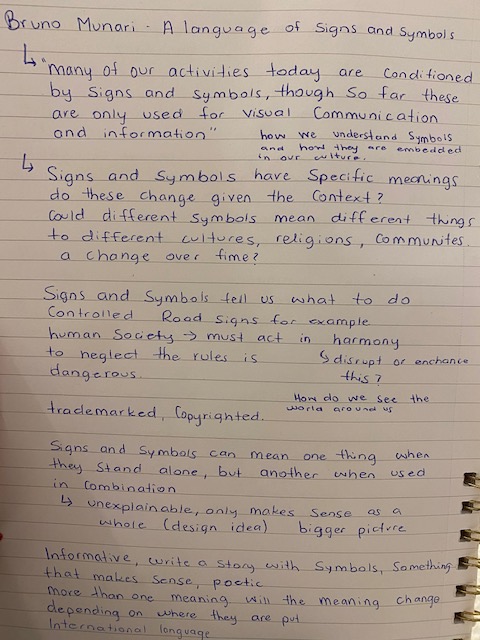
I really liked the way this text was written and how it made me think about art and design as a symbol. I thought the possibility of a ‘language of symbols’ was interesting and liked how Munari discussed ideas around the different meanings symbols could have to different people and communites.
I have decided to write one of my four annotations on this piece.
Self Chosen Resource 2: Tool Time, How Technology Uses Us by Mike Pepi
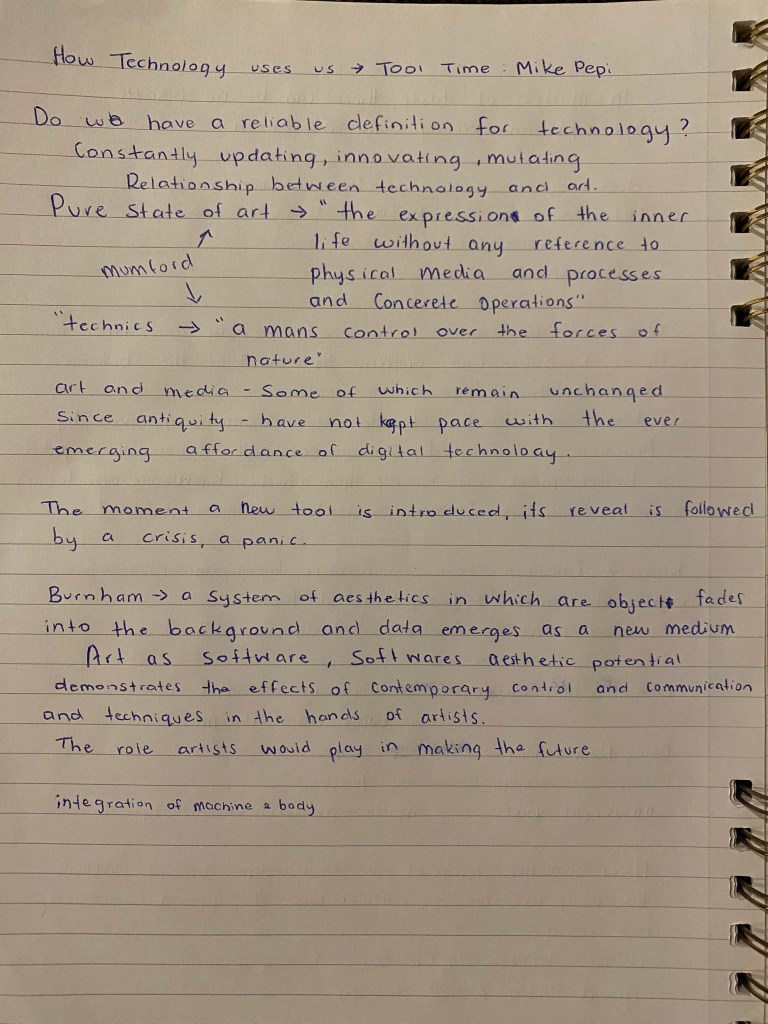
Do we have a reliable definition for technology? Can we keep up with something that is constantly updating, innovating and mutating?
Art as software. Softwares aesthetic potential.
Week 6: Fashion + Taste
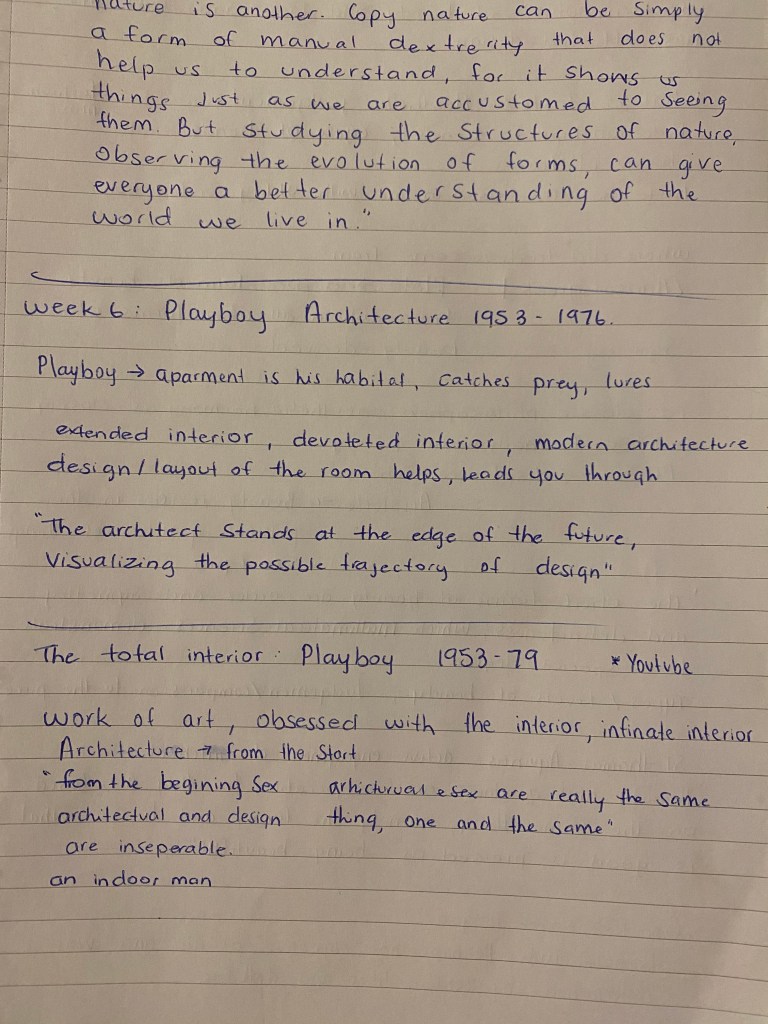
Reading: Radical Interiority: Playboy Architecture 1953-1979 by Beatriz Colomina
How does Colomina say Playboy Magazine affected reader’s tastes or desires for interior space?
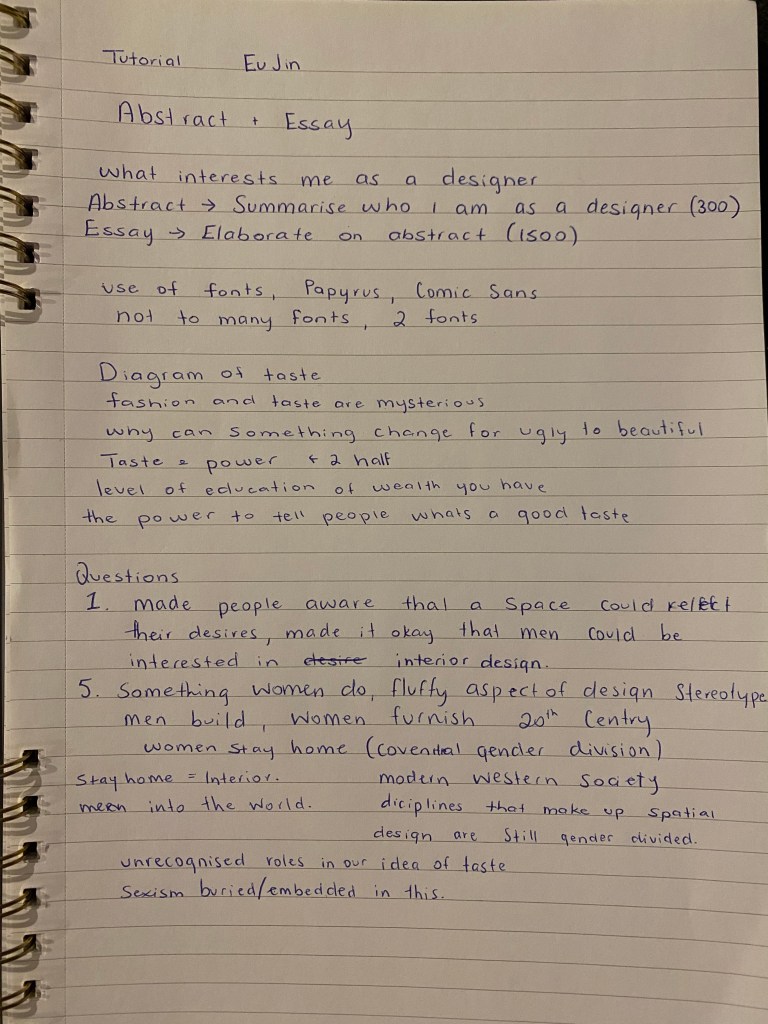
The magazine made people aware that a space could reflect their desires. Highlighting the idea that it was okay for men could be interested in interior design.
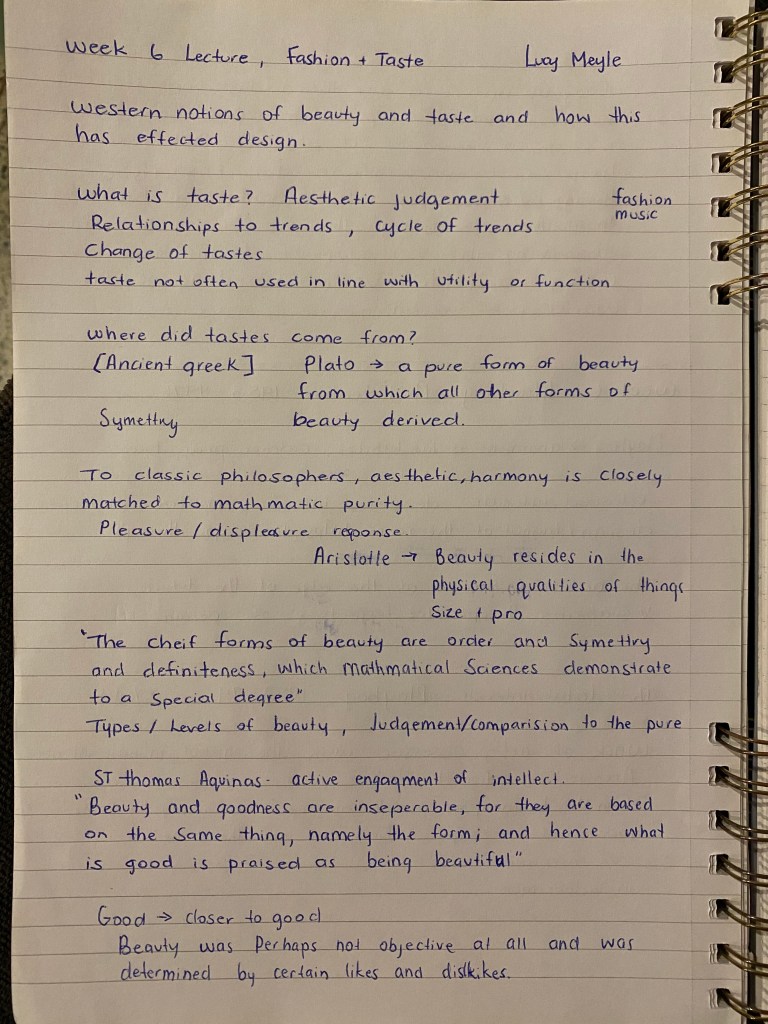
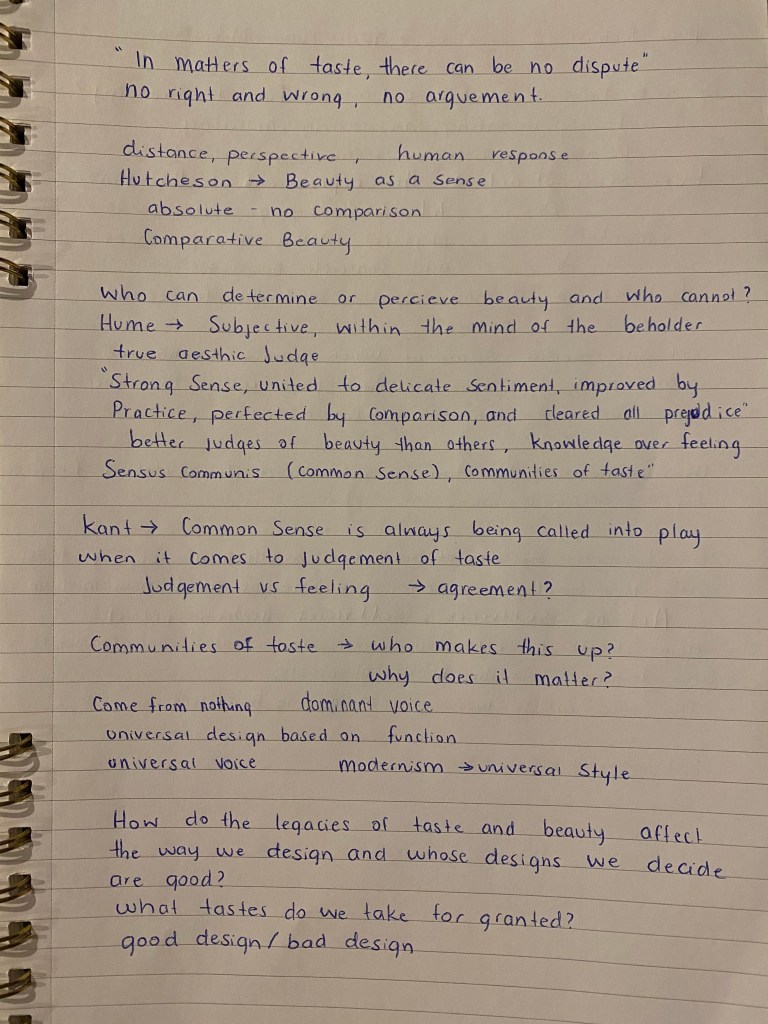
Who were some prominent Modernist designers? What do their designs have in common?
“Frank Lloyd Wright and Wallace Harrison are praised in the fourth issue for bringing modern design to the house and the skyscraper. “The exciting simplicity of modern architecture” stimulates Playboy.”
Charles Eames, Eero Saarinen, Roberto Matta are some designers.
Modernism promoted elegant and organic sleek clean lines, eliminating unneeded decorative additions. Took inspiration from technology, factories, practically and usefulness.
What is the social context of the beginnings of Playboy Magazine in 1953? What else was happening (or had happened) in the world at the time?
World War Two had just ended (1939-1945), the Great Depression was becoming a faint memory (1929-1933). Times were gentler, less violence. It was the beginning of the consumer revolution, continued economic growth. Men were often the breadwinners of the household.
How did that change between 1953-1979?
Between 1953-1979 there were a lot of protests, partially around the civil rights movement. Diversity was being fought for, people knew they had their own rights. Reconstruction from the war was finishing up resulting in an economic boom. There was a major expansion of the middle class, people could afford things like radio, television, refrigerator etc.
The sexual revolution began, changes in the moral attitudes towards sex. Sexual equality became an aim of society.
Why do you think Playboy Magazine is described by Colomina as making “it acceptable for men to be interested in modern architecture and design”? Why do you think that it might have been seen prior to this as “unacceptable” in the public consciousness?
Colomina described Playboy as the ones who were making “it acceptable for men to be interested in modern architecture and design” due to the fact that design was a huge part of why Playboy was so successful. The magazines were filled with interiors showing how it can lead someone through a room. That the architecture is just as important as as the people within the space as it controlled the environment. Readers were encouraged to think they could have a piece of the idealized interior in their own lives.
Interior design is often seen as something a woman does. This is a gender division sort of stereotype in the mind of the public consciousness. Men were seen to be the ones who went out into the world, therefore built things and were more involved with the architectural side of design. Women were thought of as the ones who stayed home in the inside, therefore furnishing the interior etc.
How does the desirable contemporary interior differ from the “Playboy Interior”, or from the Modernist interior?
……
What does Colomina say makes the Playboy Interior feel ‘futuristic’, or ‘seductive’?
Furnitures in Playboy are often curved, echoing the human body.
“In a canny seduction, the magazine describes the most advanced interior architecture design for “a man perhaps very much like you”. The reader, or the reader’s fantasy, is the client and is offered the keys to the apartment in the first page of the article.”
What interior design trends from the era feel ‘current’ and what trends feel ‘dated’?
Sleek clean and organic lines of modernism are still considered very current with many trends nowadays taking a minimalistic approach to design. The three main colour palettes used in the 1950’s (pastel, modern and Scandinavian) are still somewhat used in current designs. Fabrics with fruits, flowers and abstract designs were seen everywhere, a trend that would feel very dates nowadays.
What magazine/publication/platform would you describe as having a big influence on interior design and taste now?
Social media, such as Pinterest, Instagram, Youtube are able to promote ideas to large audiences quickly. Inspiration for all styles of architecture and design are easy accessible. People can easily keep up with what is current and trendy at all times.
How do you think social/cultural/political shifts have altered how we want to live in or design our interior spaces now?
Social media has created communal opinions on what is good taste. We want our designs to be liked by those who view it both virtually and in real life. We want to live like the people we see on social media though we are only seeing the best side of everything.
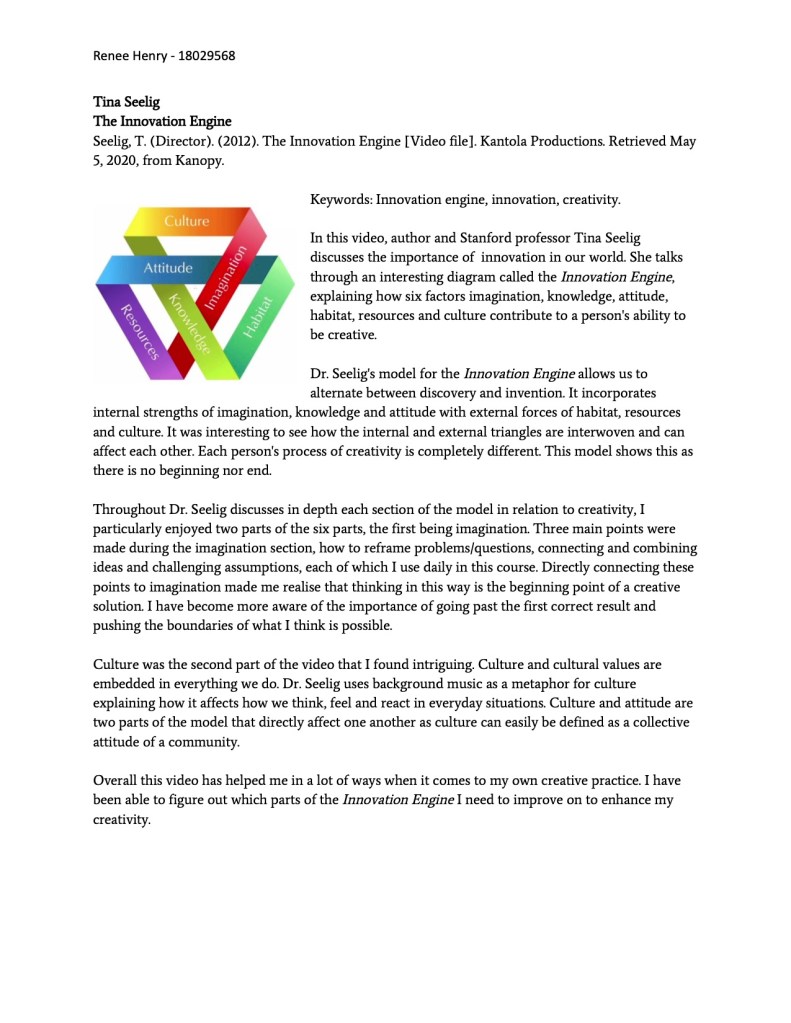
Self Chosen Resource 3: The Innovative Engine by Tina Seelig
I used this resource for one of my two self chosen text annotations.
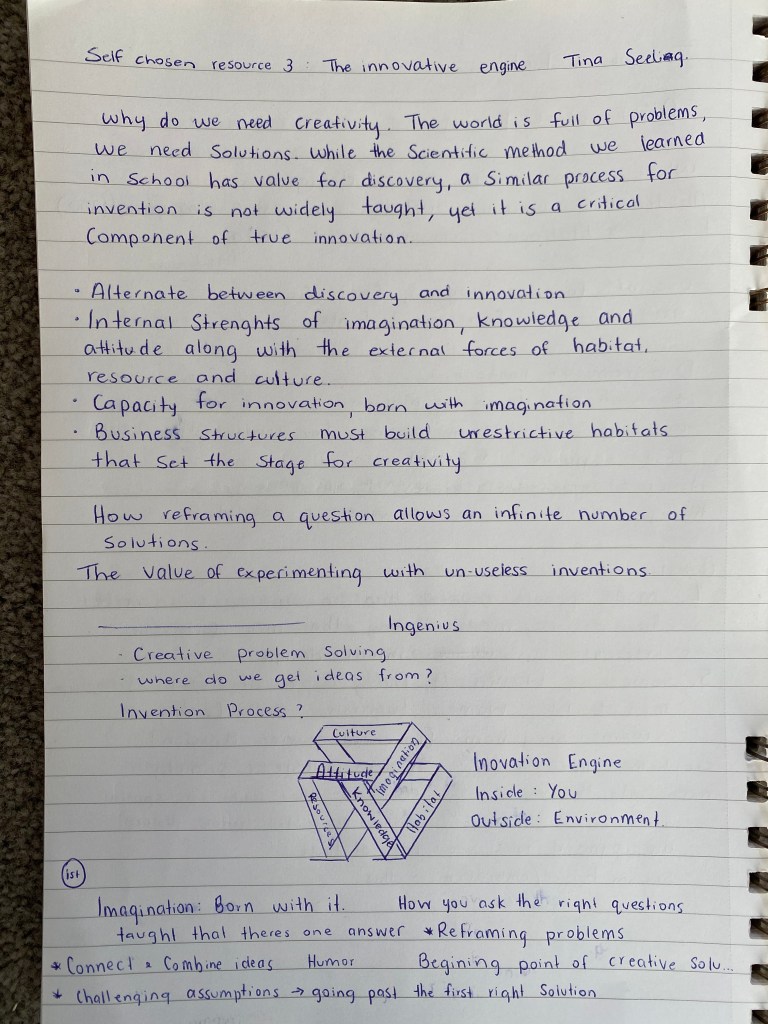
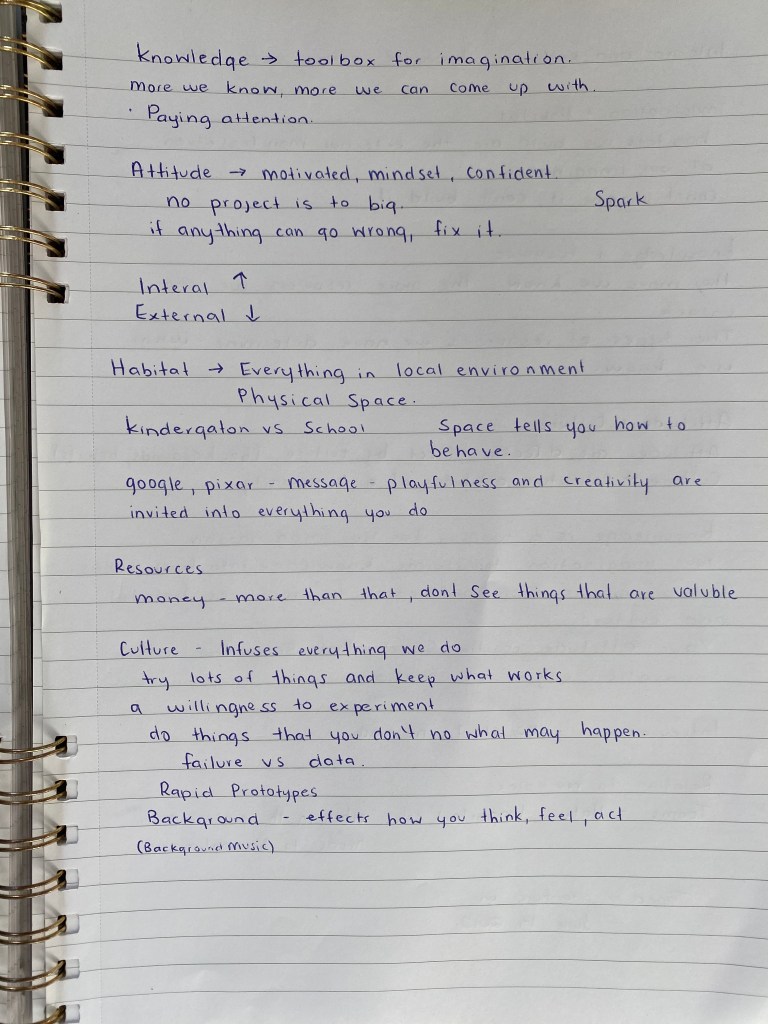
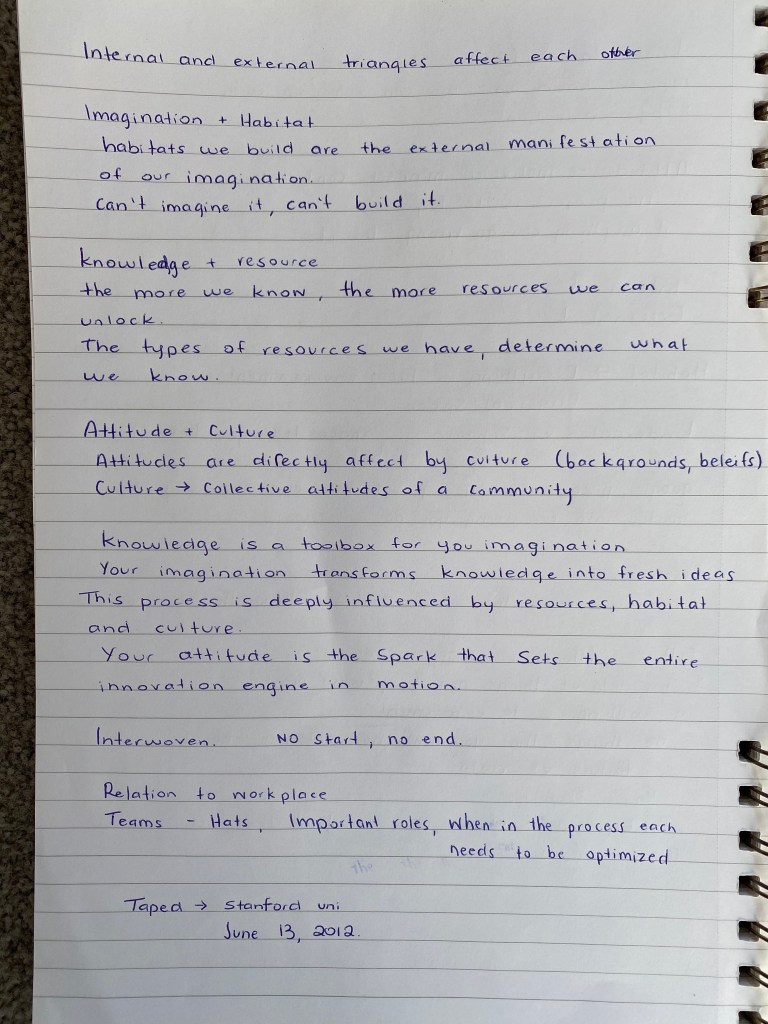
Annotations
Week 7: Heritage
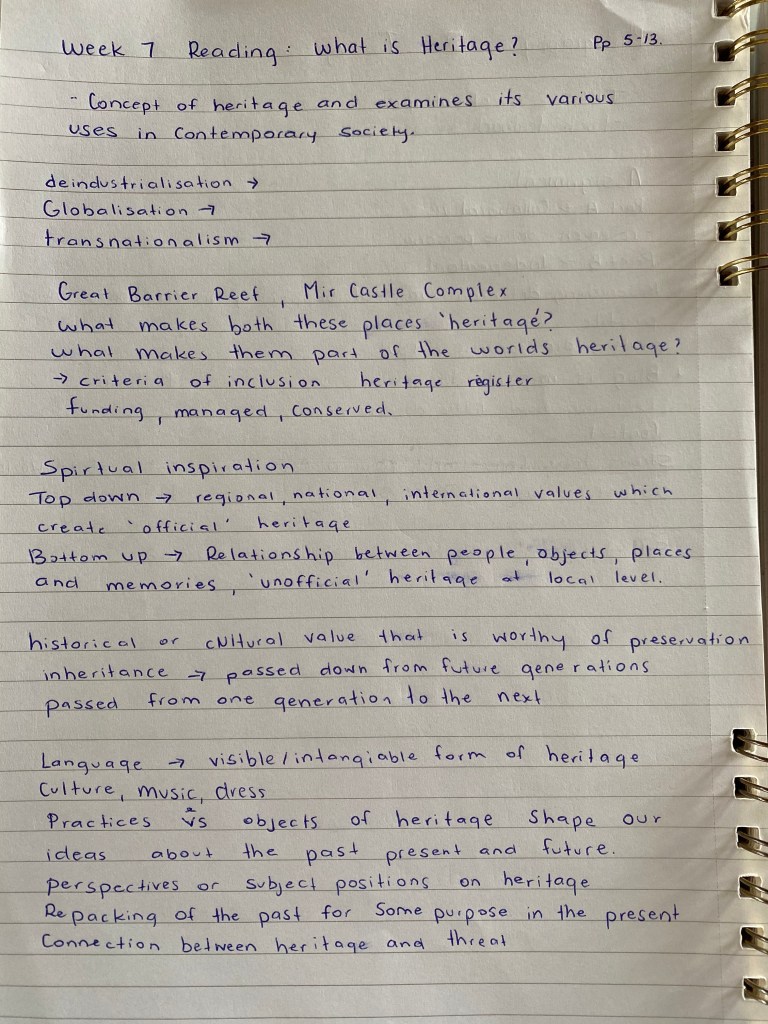
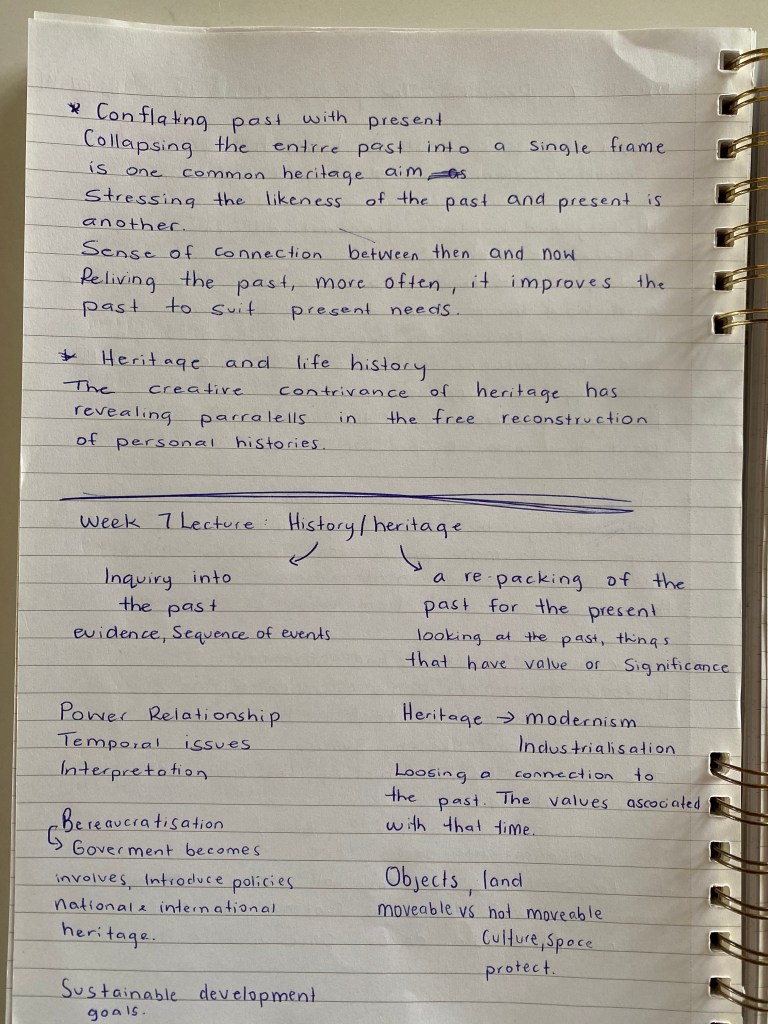
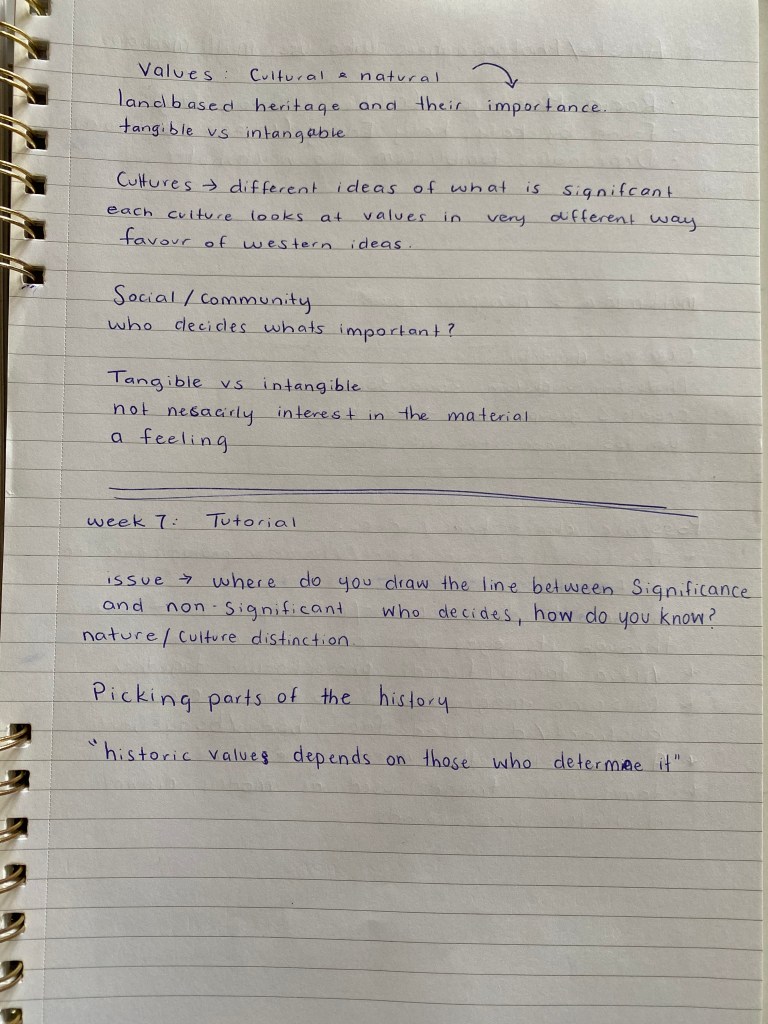
Reading one: What is Heritage? Edited by Rodney Harrison
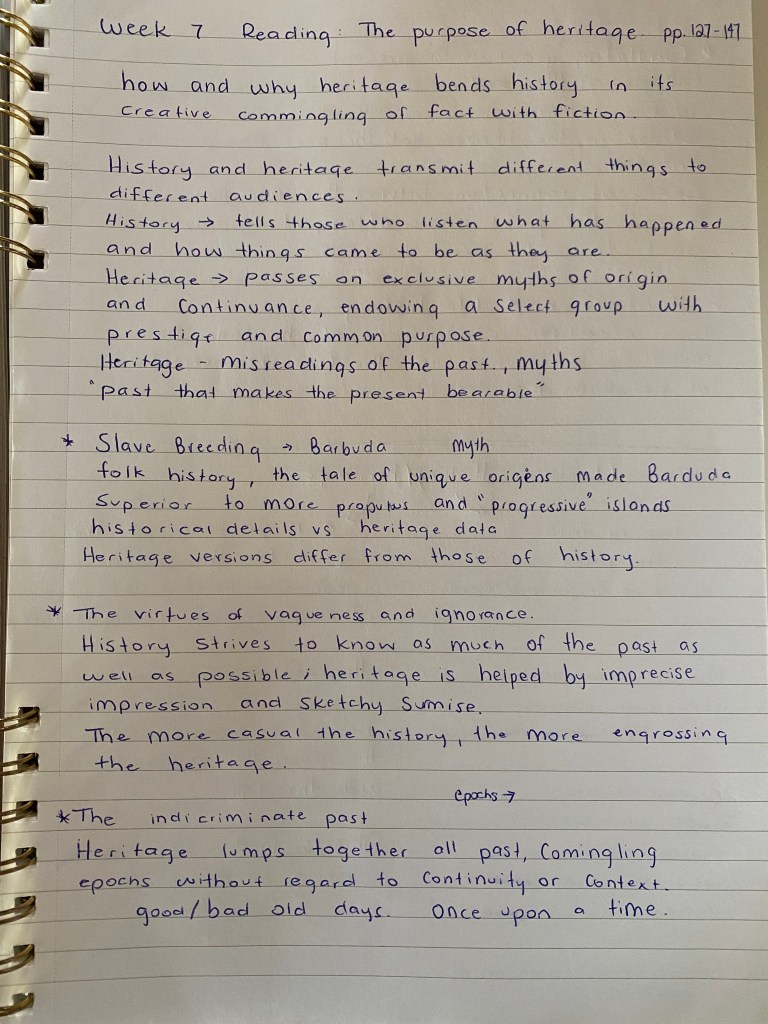
Reading two: The Purpose of Heritage pp.127-147, by David Lowenthal
Week 8: Wiggle Room
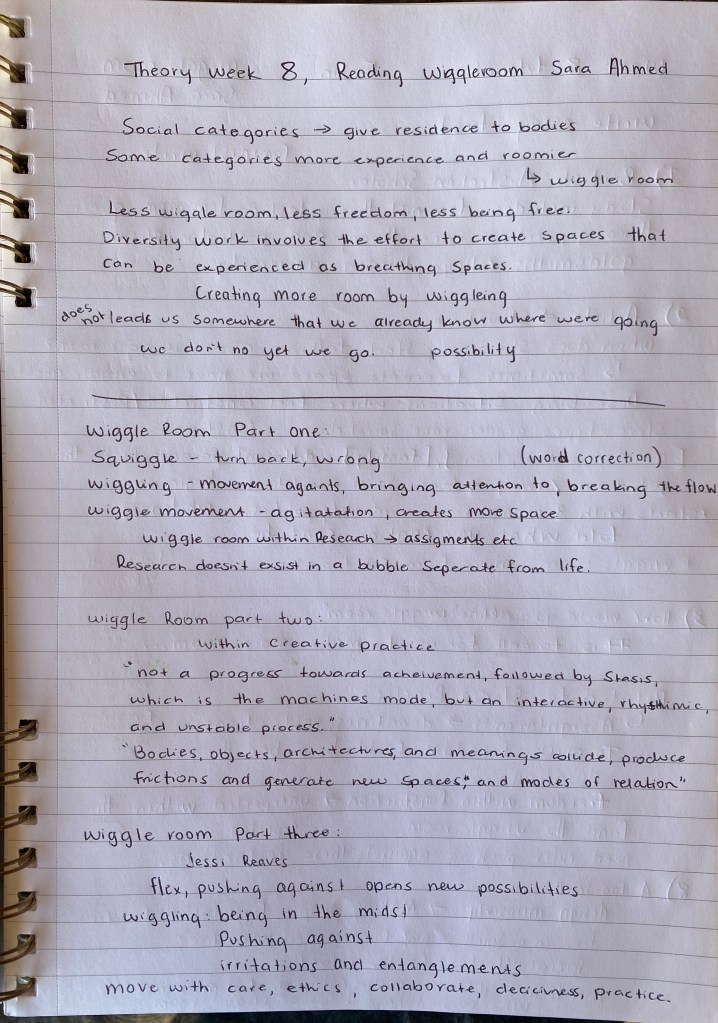
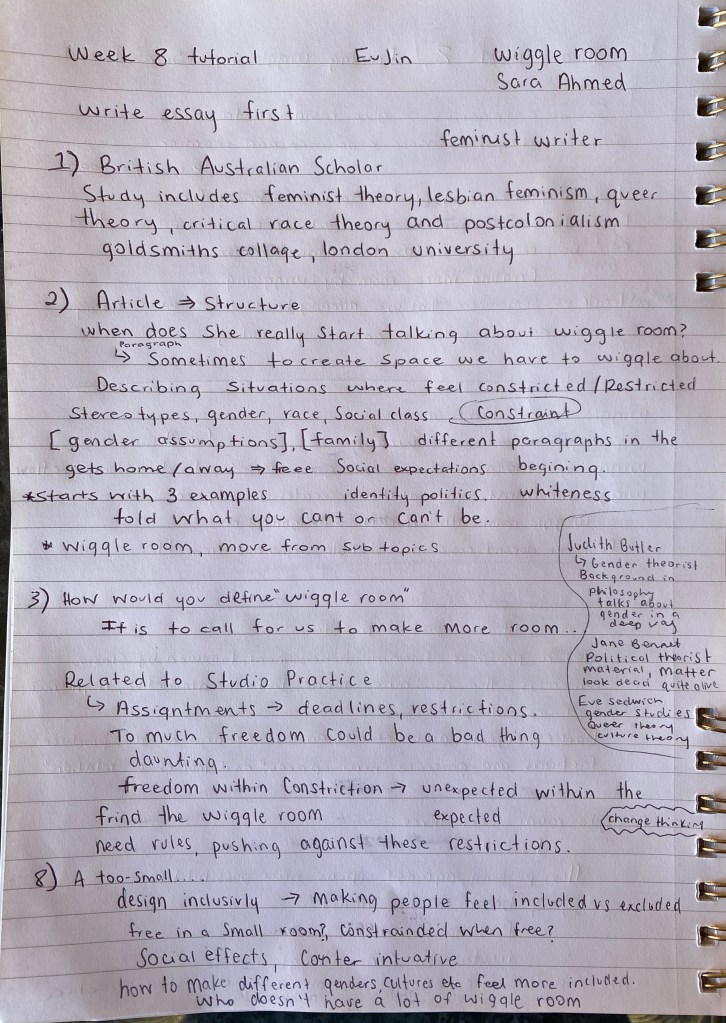
Reading: Wiggle Room by Sara Ahmed
Who is Sara Ahmed?
Sara Ahmed is a British Australian writer. Her studies involve feminist theory, lesbian feminism, queer theory, critical race and postcolonialism. Worked as Goldsmiths collage, London University.
How does Ahmed begin the text? If you noted down the ‘sections’ of this piece of writing, what would those sections cover or talk through?
First few pages describes different situations where people may feel constraint and restriction such as social exceptions, family beliefs, gender, race and social categories. She explains how people in of each of these ‘room’s’ have more or less space to wiggle depending on the ‘roominess’.
How would you define ‘wiggle room’?
I would define ‘wiggle room’ as creating the space for freedom within the constraints of restrictions that have been given.
“capacity or scope for negotiation or operation, especially in order to modify a previous statement or decision.” – Google
“It is to call for us to make more room, so that we can breath, so that even in being given assignments, we are not restricted, or less restricted, not expected to live in this way or that. In wiggling to create room we open up what it is to be.” – From the text
She connects ‘wiggling’ with the will, or willfulness. How does she say that connection came about for her?
In Sara Ahmeds project ‘Wilful subjects’ she discusses how the idea of wiggling can be connected to one’s wilfulness. Ahmed says that we would be willing to create spaces to wiggle and push against restrictions even if the space/room we were in wasn’t made for you.
“I think of wiggling as corporeal willfulness. If some have to be willful just to be, some have to wiggle to create room.”
Ahmed uses specific definitions of words and their historic uses as a way ‘in’ to an idea. Can you find an example of this?
“How queer is this will! As Eve Kosofsky Sedgwick has elaborated the word “queer” derives from the Indo-European word “twerk,” to turn or to twist, also related to the word “thwart” to transverse, perverse or to cross (1994: viii). That this word came to describe sexual subjects is no accident: those who do not follow the straight line, who to borrow Lucretius’ terms, “snap the bonds of fate,” are the perverts: swerving rather than straightening, deviating from the right course.”
What does she say is the difference between wiggling and wriggling?
“These two words “wiggle” and “wriggle” both imply sudden movements, but they have a different affective quality; at least for me. Wiggle is often defined as quick irregular sideways movements. Wriggle can mean to turn and twist in quick writhing movements.”
Wiggling is trying to fit into a space too small for ones self, pushing against the constraints of the room. Wriggling means to get comfortable within a given space, moving about to fit into a space.
How would you describe Ahmed’s writing? Formal, personal, casual, etc?
I would describe Ahmeds writing as quite personal as she writes in a way that speaks to the reader. She also includes personal references from her own life.
What effect does this have on the reader (on you!)?
Makes the text easy to understand. The personal style creates a connections between the reader and writer as both can relate to topics being written about.
A too-small room is a key metaphor that Ahmed uses to talk about ‘wiggling’ – why might it be interesting to think of as spatial designers?
As a spatial designer it is interesting to think of a too-small room as a metaphor for a space that makes people feel restricted, confined or unwelcome. It’s important to think about designing inclusively so that the spaces created allow all social categories, genders, races etc to feel like they have room to ‘wiggle’.
What else could be considered as a ‘space’ to wiggle within or what else could be considered something to wiggle ‘against’?
Space to wiggle can be seen in everyday things, for example, someone with a busy schedule may push against the constraints of time creating wiggle room, moments of freedom. Allowing small changes in the plan if needed.
When buying something the negotiation of price can be considered wiggle room, pushing to get a lower price or better deal.
Ahmed references a number of other people’s texts – who is Judith Butler? Who is Jane Bennett? Who is Eve Sedgwick?
Judith Butler – Gender theorist with a background in philosophy. Talks about gender in a deep way.
Jane Bennet – Political theorist, talks about material and matter.
Eve Sedgwick – Gender theorist interested in queer theory and culture theory.
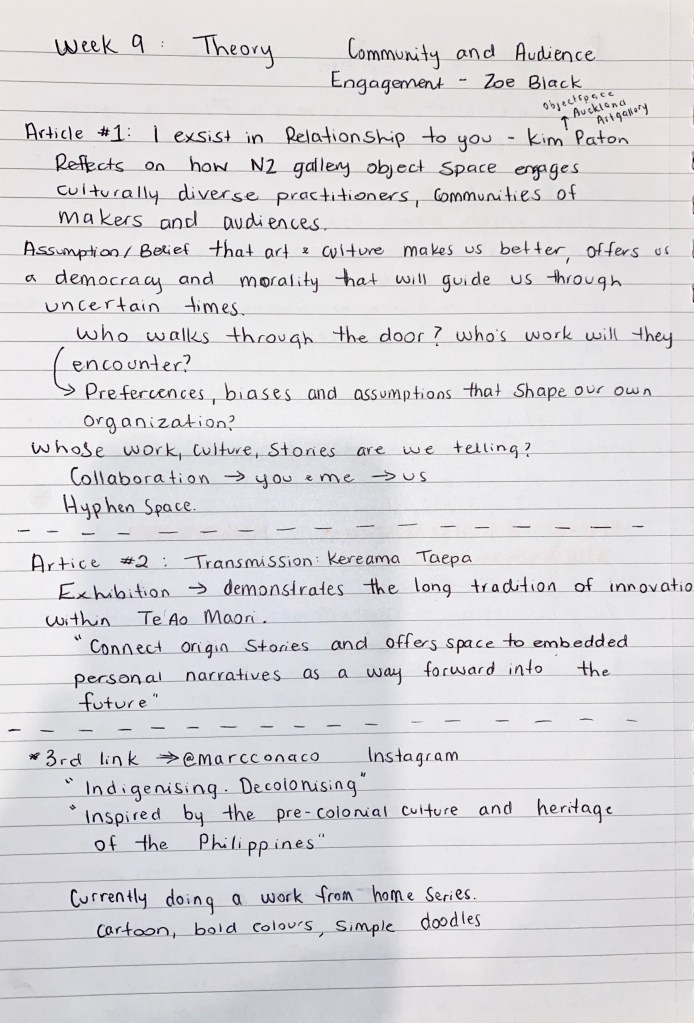
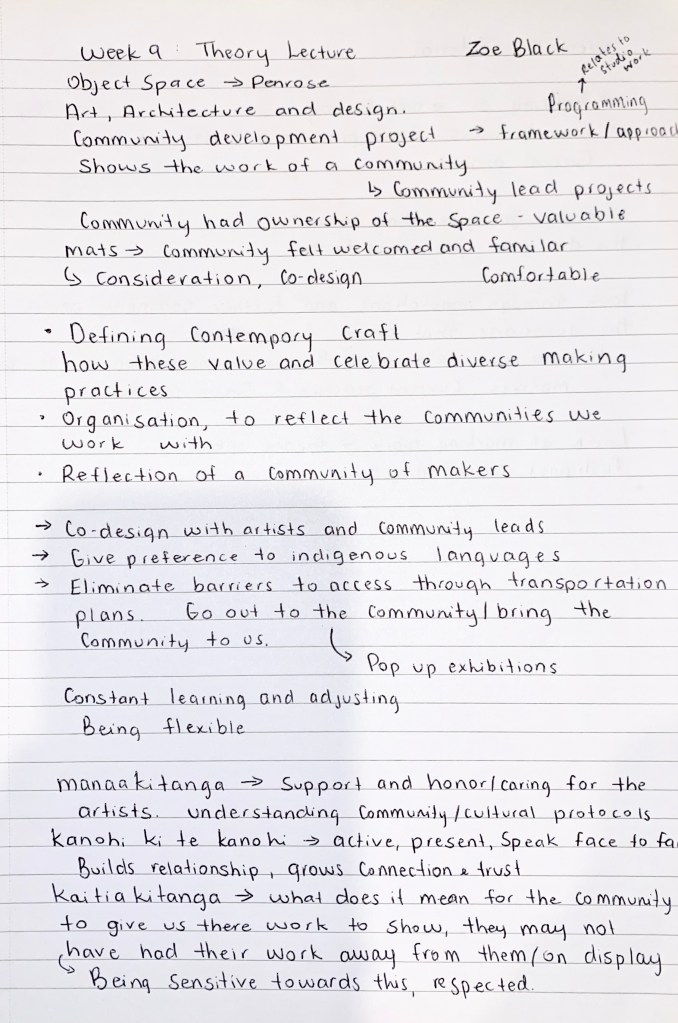
Week 9: Community and Audience Engagement
Self chosen resource: Design with nature. What does is mean to design with nature now? Ian Mcharg
“By “design with nature” McHarg meant that the way we occupy and modify the earth is best when it is planned and designed with careful regard to both the ecology and the character of the landscape. In this way, he argued that our cities, industries and farms could avoid major natural hazards and become truly regenerative . More deeply, McHarg believed that by living with rather than against the more powerful forces and flows of the landscape, communities would gain a stronger sense of place and identity.”
This text written by a number of highly educated professionals was one of the most interesting texts I have read to date. It covered themes I am interested in while looking at ideas from many different perspectives, something that I view as important.
 Spatial Design